99% 2-Phenoxyethyl acrylate

99% 2-Phenoxyethyl acrylate

Contact Us

  • Category

    Acrylate series

  • Describe

    2-Phenoxyethyl acrylate (PEA) is a functional acrylate monomer widely used in light-curing coatings, inks, adhesives and other fields. It is particularly suitable for formulations that improve flexibility, adhesion and chemical resistance.

  • Cas No.

    48145-04-6

  • Purity

    99%

  • Synonym(s)

    PHEA

Physical and chemical properties

  • 1. Chemical Identity
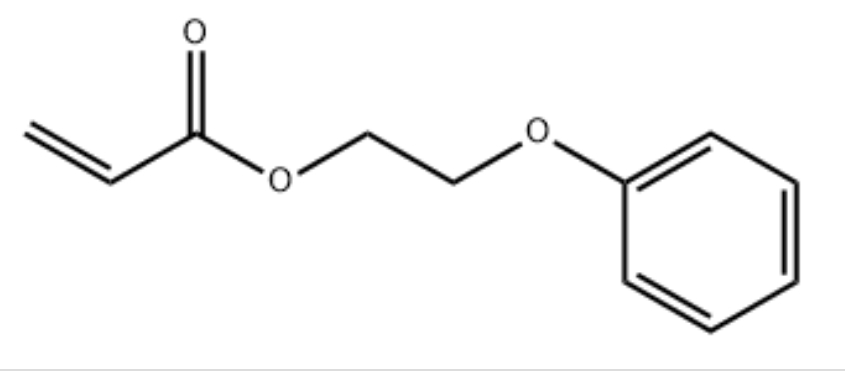
    • Chemical Name: 2-Phenoxyethyl acrylate
    • IUPAC Name: 2-Phenoxyethyl prop-2-enoate
    • Synonyms: PEA, Phenoxyethyl acrylate, Acrylic acid 2-phenoxyethyl ester
    • CAS Number: 48145-04-6
    • EC Number: 256-436-5
    • Molecular Formula: C11H12O3
    • Molecular Weight: 192.21 g/mol
  • 2. Physical Properties
    • Appearance: Clear, colorless to pale yellow liquid.
    • Odor: Mild, characteristic, ester-like.
    • Melting Point: Not available.
    • Boiling Point: 142 °C (288 °F) at 13 hPa
    • Density: 1.10 - 1.12 g/cm³ at 20 °C
    • Solubility:
    • In Water: 1.35 g/L at 20 °C (Slightly soluble)
    • In Organic Solvents: Soluble in many common organic solvents.
    • Vapor Pressure: <0.01 hPa at 20 °C
    • Viscosity: 6 - 12 mPa·s at 25 °C
  • 3. Chemical Properties and Stability
    • Stability: Stable under recommended storage conditions. Typically supplied with a polymerization inhibitor (e.g., MEHQ) to prevent spontaneous polymerization.
    • Incompatibilities: Incompatible with strong oxidizing agents, strong bases, strong acids, free-radical initiators, and peroxides.
    • Hazardous Polymerization: May occur if not properly inhibited or if exposed to high temperatures, direct sunlight, or contaminants. Polymerization is an exothermic reaction.
    • Hazardous Decomposition Products: Combustion may produce toxic fumes of carbon monoxide (CO) and carbon dioxide (CO2).
  • 4. Other Key Data
    • Flash Point: >110 °C (>230 °F) - Closed cup
    • Refractive Index (n20/D): ~1.517
 

Application

1. Photocurable materials
UV-curable coatings
Specific products: surface protective coatings for mobile phones/electronic products, varnishes for wood furniture, and photocurable coatings for automotive interiors.
Function: Provide high gloss, scratch resistance, and fast curing performance.
Photocurable inks
Specific products: photosensitive resins for 3D printing, photosensitive inks for printed circuit boards (PCBs), and packaging printing inks.
Function: Enhance adhesion, improve flexibility, and be suitable for complex substrates.

2. Adhesives and sealants
UV-curable adhesives
Specific products: electronic component encapsulation adhesives (such as LED chip encapsulation), glass/metal bonding adhesives, and medical breathable tapes.
Function: Fast curing, reduced solvent evaporation, environmentally friendly and efficient.
Pressure-sensitive adhesives (PSA)
Specific products: label adhesives, industrial tapes (such as foam tapes), and medical dressings.
Function: Improve high temperature resistance and long-term bonding stability.

3. Electronic materials
Flexible electronic devices
Specific products: encapsulation layer of flexible display panels (OLEDs), conductive adhesives for wearable devices.
Function: Enhance material flexibility and dielectric properties.
Photoresist auxiliary materials
Specific products: Sensitizers or diluents in semiconductor photolithography processes.

4. Medical and biomaterials
Dental materials
Specific products: Light-cured dental adhesives, dental restoration resins (such as tooth filling materials).
Function: Improve biocompatibility and curing speed.
Medical polymers
Specific products: Controlled release drug carriers, biosensor coatings.

5. Cosmetics and personal care
UV-cured nail products
Specific products: Phototherapy nail gel (Gel nail polish).
Function: Rapid curing to form a wear-resistant, high-gloss film layer.

6. Special polymers
Modified acrylic resins
Specific products: High-temperature resistant engineering plastics (such as electronic housings), high-transparency optical resins (lenses, light guides).
Hydrogels
Specific products: Contact lens materials, medical dressing hydrogel layers.

7. Textiles and composite materials
Functional coatings
Specific products: Waterproof/antifouling fabric coatings (outdoor clothing), flame-retardant fiber treatment agents.
Composite toughening agent
Specific products: Carbon fiber reinforced resin matrix (aerospace parts).
Key properties supporting applications
Phenoxy: Provides hydrophobicity, chemical resistance and compatibility with polar substrates.
Acrylate double bond: High reactivity, suitable for free radical polymerization (UV/heat initiation).
Flexibility: Reduces material brittleness and is suitable for flexible scenarios.

Safety Information

  • This information is a summary based on the Globally Harmonized System of Classification and Labelling of Chemicals (GHS).
  • 1. GHS Classification
    • Skin Irritation (Category 2)
    • Eye Irritation (Category 2A)
    • Skin Sensitization (Category 1)
    • Specific Target Organ Toxicity — Single Exposure (Category 3), Respiratory System
    • Hazardous to the Aquatic Environment, Chronic Hazard (Category 2)
  • 2. GHS Label Elements
    • Pictograms:
      • Exclamation Mark (GHS07)
      • Environment (GHS09)
    • Signal Word: Warning
    • Hazard Statements (H-Statements):
      • H315: Causes skin irritation.
      • H317: May cause an allergic skin reaction.
      • H319: Causes serious eye irritation.
      • H335: May cause respiratory irritation.
      • H411: Toxic to aquatic life with long lasting effects.
    • Precautionary Statements (P-Statements):
    • Prevention:
      • P261: Avoid breathing dust/fume/gas/mist/vapors/spray.
      • P272: Contaminated work clothing should not be allowed out of the workplace.
      • P273: Avoid release to the environment.
      • P280: Wear protective gloves, eye protection, and face protection.
    • Response:
      • P302 + P352: IF ON SKIN: Wash with plenty of soap and water.
      • P305 + P351 + P338: IF IN EYES: Rinse cautiously with water for several minutes. Remove contact lenses, if present and easy to do. Continue rinsing.
      • P333 + P313: If skin irritation or rash occurs: Get medical advice/attention.
      • P337 + P313: If eye irritation persists: Get medical advice/attention.
      • P362 + P364: Take off contaminated clothing and wash it before reuse.
      • P391: Collect spillage.
    • Storage:
      • P403 + P233: Store in a well-ventilated place. Keep container tightly closed.
    • Disposal:
      • P501: Dispose of contents/container to an approved hazardous waste disposal plant.
  • 3. Summary of Primary Hazards
    • Health Hazards: Causes irritation to the skin, eyes, and respiratory system. It is a skin sensitizer, meaning repeated contact may lead to an allergic skin reaction (contact dermatitis).
    • Environmental Hazards: Toxic to aquatic organisms, with the potential for long-lasting adverse effects in the aquatic environment. Release to waterways must be avoided.
    • Reactivity Hazards: The product is a monomer that can undergo hazardous polymerization if not properly stabilized and stored. Avoid exposure to high temperatures, direct sunlight, and contamination.

Follow Us
Get Updates

Contact Us