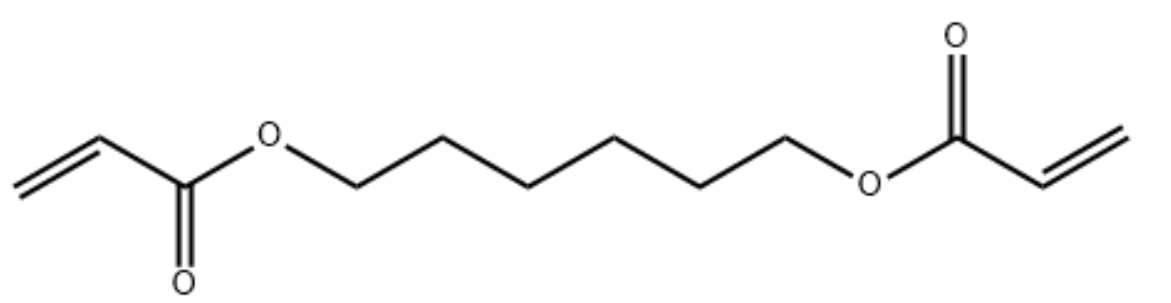
1,6-Hexanediol diacrylate

1,6-Hexanediol diacrylate

Contact Us

  • Category

    Acrylate series

  • Describe

    1,6-Hexanediol diacrylate (HDDA) is a bifunctional acrylate monomer widely used in photocuring systems, mainly to improve the hardness, wear resistance and curing speed of the coating.

  • Cas No.

    13048-33-4

  • Purity

    mixture

  • Synonym(s)

    HDDA

Physical and chemical properties

  • 1. Chemical Identity
    • Chemical Name: 1,6-Hexanediol diacrylate
    • IUPAC Name: Hexane-1,6-diyl bis(prop-2-enoate)
    • Synonyms: HDDA, Hexanediol diacrylate, 1,6-Hexamethylene diacrylate
    • CAS Number: 13048-33-4
    • EC Number: 235-921-9
    • Molecular Formula: C12​H18​O4​
    • Molecular Weight: 226.27 g/mol
  • 2. Physical Properties
    • Appearance: Clear, colorless to pale yellow liquid.
    • Odor: Mild, characteristic, ester-like.
    • Melting Point: 5 °C (41 °F)
    • Boiling Point: >250 °C (>482 °F) at 1013 hPa
    • Density: 1.01 g/cm³ at 20 °C
    • Solubility:
    • In Water: 0.3 g/L at 20 °C (Slightly soluble)
    • In Organic Solvents: Soluble in many common organic solvents (e.g., acetone, esters, aromatic hydrocarbons).
    • Vapor Pressure: <0.01 hPa at 20 °C
    • Viscosity: 6 - 12 mPa·s at 25 °C
  • 3. Chemical Properties and Stability
    • Stability: Stable under recommended storage conditions. Typically supplied with a polymerization inhibitor (e.g., MEHQ) to prevent spontaneous polymerization.
    • Incompatibilities: Incompatible with strong oxidizing agents, strong bases, strong acids, reducing agents, peroxides, and free-radical initiators.
    • Hazardous Polymerization: May occur if not properly inhibited or if exposed to high temperatures, direct sunlight, UV radiation, or contaminants. Polymerization is a highly exothermic reaction and can be violent.
    • Hazardous Decomposition Products: Combustion may produce toxic fumes of carbon monoxide (CO) and carbon dioxide (CO2​).
  • 4. Other Key Data
    • Flash Point: >120 °C (>248 °F) - Closed cup
    • Refractive Index (n20/D): ~1.456
 

Application

1. UV coatings and inks, as key monomers, are used in UV curing coatings and inks in furniture, automobiles, electronic equipment and other fields, providing fast curing, high gloss and wear resistance.

2. Photoresists and 3D printing resins, as photosensitive components in semiconductor lithography processes, are also used in stereolithography (SLA) 3D printing resins to ensure high precision and mechanical strength.

3. Adhesives, used for UV curing glue, suitable for bonding glass and plastics, with low shrinkage and high bonding strength.

4. Polymer material modification, used as a cross-linking agent: introducing a cross-linking structure into polymers (such as rubber and plastics) to improve heat resistance, solvent resistance and mechanical strength, used as a reactive diluent: reducing the viscosity of the resin system (such as epoxy or polyurethane systems), participating in the curing reaction, and reducing volatile organic compounds (VOC).

5. Packaging and insulation materials: used for LED packaging and circuit board protective coatings, providing high temperature resistance and electrical insulation properties.

6. Flexible electronic devices: as a component of a flexible substrate, it adapts to the flexibility requirements of bendable displays or wearable devices.

7. Optical materials: used for transparent plastics and optical fiber coatings, taking advantage of their high light transmittance and low yellowing properties.

8. Composite materials: used as resin matrix to reinforce carbon fiber/glass fiber composites to optimize toughness and fatigue resistance.

9. Dental materials: used for light-cured composite resins to repair teeth, ensuring rapid prototyping and biocompatibility.

10. Medical device coatings: used as antibacterial or waterproof coatings, applied to the surface of catheters and surgical tools

Safety Information

  • This information is a summary based on the Globally Harmonized System of Classification and Labelling of Chemicals (GHS).
  • 1. GHS Classification
    • Skin Irritation (Category 2)
    • Serious Eye Damage (Category 1)
    • Skin Sensitization (Category 1)
    • Specific Target Organ Toxicity — Single Exposure (Category 3), Respiratory System
    • Hazardous to the Aquatic Environment, Chronic Hazard (Category 3)
  • 2. GHS Label Elements
    • Pictograms:
      • Corrosion (GHS05)
      • Exclamation Mark (GHS07)
    • Signal Word: Danger
    • Hazard Statements (H-Statements):
      • H315: Causes skin irritation.
    • H317: May cause an allergic skin reaction.
    • H318: Causes serious eye damage.
    • H335: May cause respiratory irritation.
    • H412: Harmful to aquatic life with long lasting effects.
    • Precautionary Statements (P-Statements):
    • Prevention:
      • P261: Avoid breathing dust/fume/gas/mist/vapors/spray.
      • P272: Contaminated work clothing should not be allowed out of the workplace.
      • P280: Wear protective gloves, protective clothing, eye protection, and face protection.
    • Response:
      • P302 + P352: IF ON SKIN: Wash with plenty of soap and water.
      • P305 + P351 + P338 + P310: IF IN EYES: Rinse cautiously with water for several minutes. Remove contact lenses, if present and easy to do. Continue rinsing. Immediately call a POISON CENTER or doctor/physician.
      • P333 + P313: If skin irritation or rash occurs: Get medical advice/attention.
      • P362 + P364: Take off contaminated clothing and wash it before reuse.
    • Storage:
      • P403 + P233: Store in a well-ventilated place. Keep container tightly closed.
    • Disposal:
      • P501: Dispose of contents/container to an approved hazardous waste disposal plant.
  • 3. Summary of Primary Hazards
    • Health Hazards: Causes serious, potentially irreversible, eye damage. Causes skin irritation and can lead to an allergic skin reaction (contact dermatitis) upon repeated contact. Vapors or mists may cause respiratory irritation.
    • Environmental Hazards: Harmful to aquatic life with long-lasting effects. Release into the environment should be avoided.
    • Reactivity Hazards: The product is a reactive monomer that can undergo hazardous polymerization if not properly stabilized and handled. Keep away from heat, sunlight, and contamination.

Follow Us
Get Updates

Contact Us