Trimethylolpropane trimethacrylate

Trimethylolpropane trimethacrylate

Contact Us

  • Category

    Acrylate series

  • Describe

    Trimethylolpropane trimethacrylate (TMPTMA) is a trifunctional methacrylate monomer, which is widely used in photocuring systems that require high crosslinking density, high strength and chemical resistance, such as UV coatings, inks, adhesives, 3D printing materials, electronic packaging, etc.

  • Cas No.

    3290-92-4

  • Purity

    mixture

  • Synonym(s)

    TMPTMA

Physical and chemical properties

  • 1. Chemical Identity
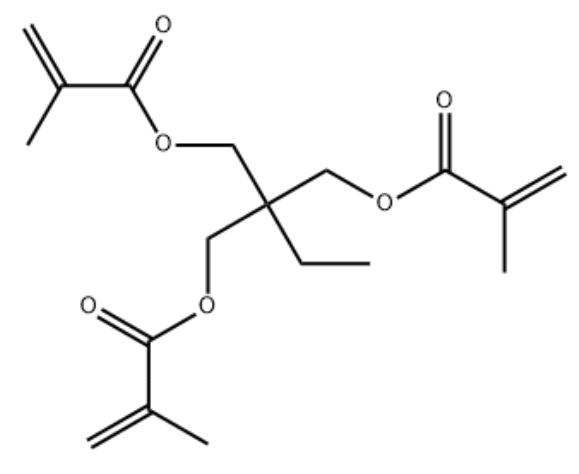
    • Chemical Name: Trimethylolpropane trimethacrylate
    • IUPAC Name: [2-Ethyl-2-[(2-methylprop-2-enoyl)oxymethyl]propane-1,3-diyl] bis(2-methylprop-2-enoate)
    • Synonyms: TMPTMA, 2-Ethyl-2-(hydroxymethyl)-1,3-propanediol trimethacrylate
    • CAS Number: 3290-92-4
    • EC Number: 221-950-4
    • Molecular Formula: C18​H26​O6​
    • Molecular Weight: 338.40 g/mol
  • 2. Physical Properties
    • Appearance: Clear, colorless to pale yellow viscous liquid.
    • Odor: Mild, characteristic, ester-like.
    • Melting Point: -25 °C (-13 °F)
    • Boiling Point: >220 °C (>428 °F) at 1 hPa (Decomposes)
    • Density: 1.06 g/cm³ at 20 °C
    • Solubility:
    • In Water: < 0.1 g/L at 20 °C (Insoluble)
    • In Organic Solvents: Soluble in many common organic solvents.
    • Vapor Pressure: <0.01 hPa at 20 °C
    • Viscosity: 40 - 60 mPa·s at 25 °C
  • 3. Chemical Properties and Stability
    • Stability: Stable under recommended storage conditions. Typically supplied with a polymerization inhibitor (e.g., MEHQ).
    • Incompatibilities: Incompatible with strong oxidizing agents, strong bases, strong acids, reducing agents, peroxides, and free-radical initiators.
    • Hazardous Polymerization: May occur if not properly inhibited or if exposed to high temperatures, direct sunlight, UV radiation, or contaminants. Polymerization is a highly exothermic reaction.
    • Hazardous Decomposition Products: Combustion may produce toxic fumes of carbon monoxide (CO) and carbon dioxide (CO2​).
  • 4. Other Key Data
    • Flash Point: >145 °C (>293 °F) - Closed cup
    • Refractive Index (n20/D): ~1.472
 

Application

1. Cross-linking agent for polymer materials, plastic and rubber modification: added as a cross-linking agent to polymers (such as PVC, rubber, etc.), significantly improving the hardness, heat resistance, chemical corrosion resistance and mechanical strength of the material; coatings and coatings: used to prepare highly wear-resistant and high-gloss industrial coatings, especially in scenarios that require weather resistance and scratch resistance.

2. Photocurable materials, UV curing systems: used as active diluents and cross-linking agents in UV curing coatings, inks, and adhesives, rapidly polymerize through photoinitiators to form a dense network structure, increase the curing speed and high cross-linking density, and form a cured film with excellent solvent resistance and hardness and scratch resistance. It is mainly used as a reactive diluent for UV curing coatings and inks, diluting before irradiation and participating in the reaction after irradiation to form part of the cured film; 3D printing photosensitive resin: used in stereolithography (SLA) or digital light processing (DLP) technology to enhance the impact resistance and dimensional stability of printed parts.

3. 1. Dental materials, composite resins: as key components of dental restorative materials (such as filling resins and adhesives), they provide fast curing ability and high mechanical strength while reducing shrinkage stress; 2. Denture base materials: used to improve the wear resistance and deformation resistance of dentures.

4. Electronic materials, packaging and insulation materials: in the packaging glue of electronic components or the insulation layer of printed circuit boards (PCBs), its high cross-linking density is used to achieve excellent dielectric properties and high temperature resistance; photoresist additives: improve the resolution and etching resistance of photoresists; in the electronics field, TMPTMA can be used in photocurable glues, conductive glues and packaging materials to meet the special needs of electronic components.

5. Adhesives and sealants, reactive diluents: reduce the viscosity of the system in acrylic adhesives, participate in the curing reaction, and enhance the bonding strength and aging resistance; structural adhesives: used for high-strength bonding needs in the automotive, aerospace and other fields.

6. Rubber industry, vulcanization aid: In the peroxide vulcanization system, TMPTMA can improve the cross-linking efficiency of rubber products, improve heat resistance and compression set. In the vulcanization process of special rubber, TMPTMA can be used as a vulcanization activator to significantly shorten the vulcanization time, improve the degree of vulcanization, and enhance the mechanical strength, wear resistance, solvent resistance and corrosion resistance of the product. For example, in the vulcanization process of fluorine-containing rubber, TMPTMA can absorb the hydrogen halide released during the processing and improve the quality of the product.

VII. Polymer modification: TMPTMA can be used for polymer modification to improve the chemical resistance, thermal properties and mechanical properties of polymers. It can also be used as a plasticizer for coatings and inks to improve the wear resistance and chemical resistance of the coating.

Safety Information

  • This information is a summary based on the Globally Harmonized System of Classification and Labelling of Chemicals (GHS).
    • 1. GHS Classification
      • Skin Sensitization (Category 1)
      • Reproductive Toxicity (Category 2)
      • Hazardous to the Aquatic Environment, Chronic Hazard (Category 4)
    • 2. GHS Label Elements
      • Pictograms:
        • Exclamation Mark (GHS07)
        • Health Hazard (GHS08)
      • Signal Word: Warning
      • Hazard Statements (H-Statements):
        • H317: May cause an allergic skin reaction.
        • H361f: Suspected of damaging fertility.
        • H413: May cause long lasting harmful effects to aquatic life.
      • Precautionary Statements (P-Statements):
      • Prevention:
        • P201: Obtain special instructions before use.
        • P261: Avoid breathing dust/fume/gas/mist/vapors/spray.
        • P272: Contaminated work clothing should not be allowed out of the workplace.
        • P280: Wear protective gloves, protective clothing, eye protection, and face protection.
      • Response:
        • P302 + P352: IF ON SKIN: Wash with plenty of soap and water.
        • P308 + P313: IF exposed or concerned: Get medical advice/attention.
        • P333 + P313: If skin irritation or rash occurs: Get medical advice/attention.
        • P362 + P364: Take off contaminated clothing and wash it before reuse.
      • Storage:
        • P405: Store locked up.
      • Disposal:
        • P501: Dispose of contents/container to an approved hazardous waste disposal plant.
    • 3. Summary of Primary Hazards
      • Health Hazards: It is a known skin sensitizer, meaning that repeated or prolonged contact can lead to the development of an allergic skin reaction (contact dermatitis). It is also suspected of damaging fertility. While not classified as a skin or eye irritant, good industrial hygiene practices should always be followed.
      • Environmental Hazards: May cause long-lasting harmful effects to aquatic life. Release into the environment should be avoided.
      • Reactivity Hazards: The product is a trifunctional reactive monomer that can undergo hazardous polymerization if not properly stabilized and handled. Keep away from heat, sunlight, and contamination.

Follow Us
Get Updates

Contact Us