Ditrimethylolpropane acrylate

Ditrimethylolpropane acrylate

Contact Us

  • Category

    Acrylate series

  • Describe

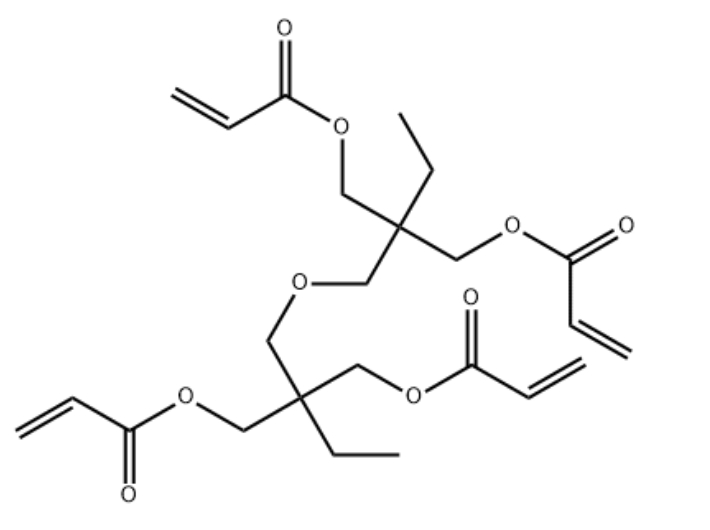
    Ditrimethylolpropane acrylate (DITMPTA) is a difunctional acrylate active monomer, which is structurally composed of two trimethylolpropane (TMP) units connected by a connecting bridge, and each TMP unit has an acrylate group.

  • Cas No.

    94108-97-1

  • Purity

    mixture

  • Synonym(s)

    DITMPTA

Physical and chemical properties

  • 1. Chemical Identity
    • Chemical Name: Ditrimethylolpropane tetraacrylate
    • IUPAC Name: (3-Acryloyloxy-2,2-bis(acryloyloxymethyl)propyl) 2,2-bis(acryloyloxymethyl)butyl acrylate
    • Synonyms: Di-TMPTA, Di-TMPTTA
    • CAS Number: 29570-58-9
    • EC Number: 249-708-3
    • Molecular Formula: C24​H34​O10​
    • Molecular Weight: 482.52 g/mol
  • 2. Physical Properties
    • Appearance: Clear, colorless to pale yellow viscous liquid.
    • Odor: Mild, characteristic, acrylic/ester-like.
    • Melting Point: Not available.
    • Boiling Point: >250 °C (>482 °F) (Decomposes)
    • Density: 1.11 g/cm³ at 20 °C
    • Solubility:
    • In Water: < 0.1 g/L (Insoluble)
    • In Organic Solvents: Soluble in many common organic solvents.
    • Vapor Pressure: <0.01 hPa at 20 °C
    • Viscosity: 500 - 800 mPa·s at 25 °C
  • 3. Chemical Properties and Stability
    • Stability: Stable under recommended storage conditions. Typically supplied with a polymerization inhibitor (e.g., MEHQ).
    • Incompatibilities: Incompatible with strong oxidizing agents, strong bases, strong acids, reducing agents, peroxides, and free-radical initiators.
    • Hazardous Polymerization: May occur if not properly inhibited or if exposed to high temperatures, direct sunlight, UV radiation, or contaminants. Polymerization is a highly exothermic reaction.
    • Hazardous Decomposition Products: Combustion may produce toxic fumes of carbon monoxide (CO) and carbon dioxide (CO2​).
  • 4. Other Key Data
    • Flash Point: >150 °C (>302 °F) - Closed cup
    • Refractive Index (n20/D): ~1.481
 

Application

1. Coatings and UV curing agents: DI-TMPTA can be used as a curing agent for coatings and other industries due to its high reactivity and excellent cross-linking properties, significantly improving the adhesion, wear resistance and corrosion resistance of coatings, the hardness and chemical resistance of products, and giving materials good gloss and adhesion. Composite material curing agent (such as fiberglass products, carbon fiber prepreg).

2. Adhesives: In adhesives, DI-TMPTA, as a tackifier, can increase the viscosity and bonding strength of adhesives and enhance their durability, electronic adhesives (such as PCB board packaging glue, display optical glue), pressure-sensitive tapes (such as industrial double-sided adhesives, electronic component fixing glue).

3. Elastomers: As a modifier for elastomers, DI-TMPTA can improve the toughness, strength and wear resistance of elastomers.

4. Wood coatings and plastic coatings: It is also commonly used in wood coatings and plastic coatings such as floor paint, piano paint, furniture paint, such as mobile phone case UV hardening coating, and car lampshade coating.

5. Ink: In the ink industry, DI-TMPTA is also widely used to improve the printing effect and durability of inks, photocurable printing inks (such as packaging printing inks, label inks).

6. Optical fiber protective coatings, flexible circuit board covering films, antibacterial coatings on medical device surfaces, and 3D printing photosensitive resins.

Safety Information

  • This information is a summary based on the Globally Harmonized System of Classification and Labelling of Chemicals (GHS).
    • 1. GHS Classification
      • Skin Irritation (Category 2)
      • Serious Eye Damage (Category 1)
      • Skin Sensitization (Category 1)
      • Hazardous to the Aquatic Environment, Chronic Hazard (Category 2)
    • 2. GHS Label Elements
      • Pictograms:
        • Corrosion (GHS05)
        • Exclamation Mark (GHS07)
        • Environment (GHS09)
      • Signal Word: Danger
      • Hazard Statements (H-Statements):
        • H315: Causes skin irritation.
        • H317: May cause an allergic skin reaction.
        • H318: Causes serious eye damage.
        • H411: Toxic to aquatic life with long lasting effects.
      • Precautionary Statements (P-Statements):
      • Prevention:
        • P261: Avoid breathing dust/fume/gas/mist/vapors/spray.
        • P272: Contaminated work clothing should not be allowed out of the workplace.
        • P280: Wear protective gloves, protective clothing, eye protection, and face protection.
      • Response:
        • P302 + P352: IF ON SKIN: Wash with plenty of soap and water.
        • P305 + P351 + P338 + P310: IF IN EYES: Rinse cautiously with water for several minutes. Remove contact lenses, if present and easy to do. Continue rinsing. Immediately call a POISON CENTER or doctor/physician.
        • P333 + P313: If skin irritation or rash occurs: Get medical advice/attention.
        • P362 + P364: Take off contaminated clothing and wash it before reuse.
        • P391: Collect spillage.
      • Storage:
      • Store in a cool, dark, well-ventilated place.
      • Disposal:
        • P501: Dispose of contents/container to an approved hazardous waste disposal plant.
    • 3. Summary of Primary Hazards
      • Health Hazards: Causes serious, potentially irreversible, eye damage. Causes skin irritation and is a known skin sensitizer, meaning repeated contact can lead to the development of an allergic skin reaction (contact dermatitis).
      • Environmental Hazards: Toxic to aquatic life with long-lasting effects. Release into the environment should be avoided.
      • Reactivity Hazards: The product is a tetrafunctional reactive monomer that can undergo hazardous polymerization if not properly stabilized and handled. Keep away from heat, sunlight, and contamination.

Follow Us
Get Updates

Contact Us